
The First National: A Disaster in Three Acts
I've reached a point in my life where going to the supermarket is a day out.
―Ashley Jensen
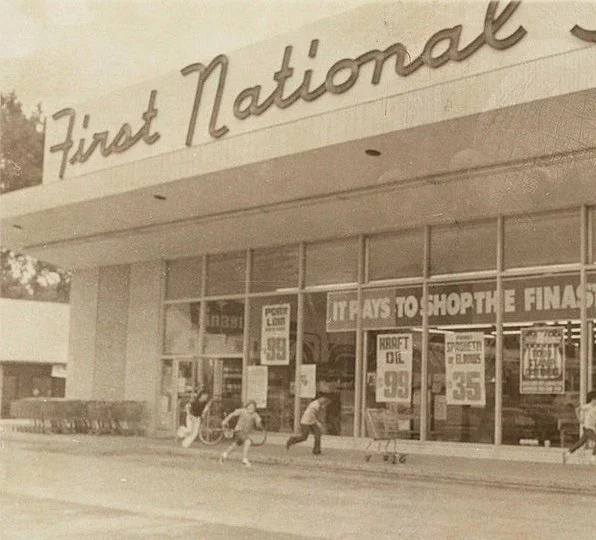
In the summer, the First National Supermarket was less a grocery store for us Coughlins and more of a warm weather retreat.
The triple decker on Liberty Street had never heard of air conditioning, much less entertained the idea of installing it. We had two box fans in the windows. Ma had pointed them outward with the hope that they would “draw the hot air out of the house.”
Even at age five, this struck me as thermodynamically suspect.
So when Ma said one sweltering summer day, “Come on, we’re going to the store,” I was totally on board. The First National was cool. Bright. Predictable. It hummed with the steady rhythm of commerce and refrigeration.
It also turned out to be an excellent laboratory.
Exhibit A: The Lobster Tank (My Origin Story)
We had made it up and down several aisles without incident, my personal best, when I saw something that changed everything.
Toward the back of the store, near the fish department, I suddenly noticed the lobster tank.
Forty-five miles from the ocean, and yet there they were. Real, live lobsters suspended in a glass tank. Their claws banded. Their antennae drifting to and fro. They looked prehistoric. Ancient. And slightly annoyed.
They stared at me.
I stared at them.
We regarded one another.
Ma continued pushing the cart, unaware that I had entered into a silent maritime summit with several crustaceans.
I lingered. Possibly longer than advisable. At some point, I realized I should probably rejoin her. I turned down the aisle. She wasn’t there.
Next aisle. No Ma.
And the next. Still no Ma.
Someone yelled, “No running in the store, kid!” as I tore past him, but by then the situation had escalated beyond store policy.
I could not find her.
So I deployed one of my more reliable superpowers.
I cried.
Not dignified tears. Full-volume, snot-nosed, tile-bouncing wailing. The kind of crying that stops shoppers in their tracks.
A store employee, a stock boy, perhaps, retrieved me and handed me off to the manager, who sat me on a small shelf along the Pine Street windows, a low ledge about a foot off the ground, near the registers.
He asked my name. And then proceeded to broadcast it over the loudspeaker. Throughout the entire First National Supermarket.
Somewhere, probably Frozen Foods, Ma froze.
She appeared shortly thereafter, relieved, composed, and not especially angry. I suspect that in her mind, the fright and the public address humiliation were punishment enough.
Lesson learned. Or so she thought.
Exhibit B: The Total Collapse of the Executive Branch
Sometime later, weeks, perhaps months, I accompanied Ma to the First National again. Immediately upon entering the store, I encountered The Display.
It was a thing of beauty. A massive, hand-stacked pyramid of books about United States Presidents right there near the registers, just as you walked into the store. Hours of supermarket craftsmanship. Each week a new volume was added, and by this time the structure had grown into an architectural marvel. A feat of supermarket engineering. A monument to executive leadership and retail ambition.
Now, I was approximately two feet tall. Corduroys humming with static. With zero respect for structural engineering and completely unaware of gravitational consequences.
The books at my eye level were near the bottom. Naturally, I grabbed one.
I have never experienced a tornado firsthand, but I imagine the sound is similar to what followed. A low rumble, escalating into a full-blown freight-train roar. Down went Washington. Down went Lincoln. Theodore Roosevelt took a direct hit. Adams and Jefferson cascaded across the linoleum in presidential disarray.
It was a full-scale Executive Branch collapse.
Ma hadn’t even had time to find a shopping cart that pushed straight. We had been inside the store for approximately one minute.
Not ten minutes. Not five. One.
The shopping had not even begun.
After surveying the devastation, Ma did something both practical and brilliant. She asked the manager if I could sit on the Pine Street window shelf while she shopped.
And so I did. In public view. Customers coming and going. Registers ringing.
And there I sat, legs dangling, feet banging against the shelf. Perched like a miniature philosopher in exile. Tiny Dostoevsky, contemplating gravity and the fragility of pyramidal displays.
Exhibit C: The Price Tag Rebellion
Following the Presidential Incident, I was under increased scrutiny whenever I entered the First National.
One day, as I trailed behind Ma’s cart in apparent compliance, I noticed something remarkable. Grocery shelves had small plastic price tags clipped into a thin metal lip beneath each product. They displayed the item price, price per unit, and other economic truths.
What fascinated me was that these small plastic price tags were not glued in place.
In fact, they moved. I discovered this by gently pushing one.
It slid. That alone was thrilling.
But then something even more magnificent happened: it bumped into the next one. Which bumped into the next one. Which bumped into the next one. At age five, I had discovered retail dominoes.
Some popped free and fluttered to the floor. Others stayed in their tracks, forming a growing bulge of displaced pricing information. The sound alone was deeply satisfying:
Click. Click. Click-click-click.
By the time we were three-quarters of the way down the aisle, the floor behind me was littered with fallen price tags, and I was pushing along a thick, jammed stack of red and white price tags. It was, in its own way, beautiful. In my mind, I was conducting important research.
Then came the voice.
“OH, NO!”
Ma turned, and once again understood why I had been so quiet.
After these episodes, I did not accompany Ma to the First National very often. At least not without heightened supervision in the form of one of my older sisters.
Looking back, I realize I was not a destructive child. Certainly not in a malicious sense.
I was curious.
Unfortunately, the First National was not equipped to function as a testing facility for gravity, supply chains, or maritime crustaceans.
But it was cool in the summer.
And for a while, that was enough.