
At a Certain Time
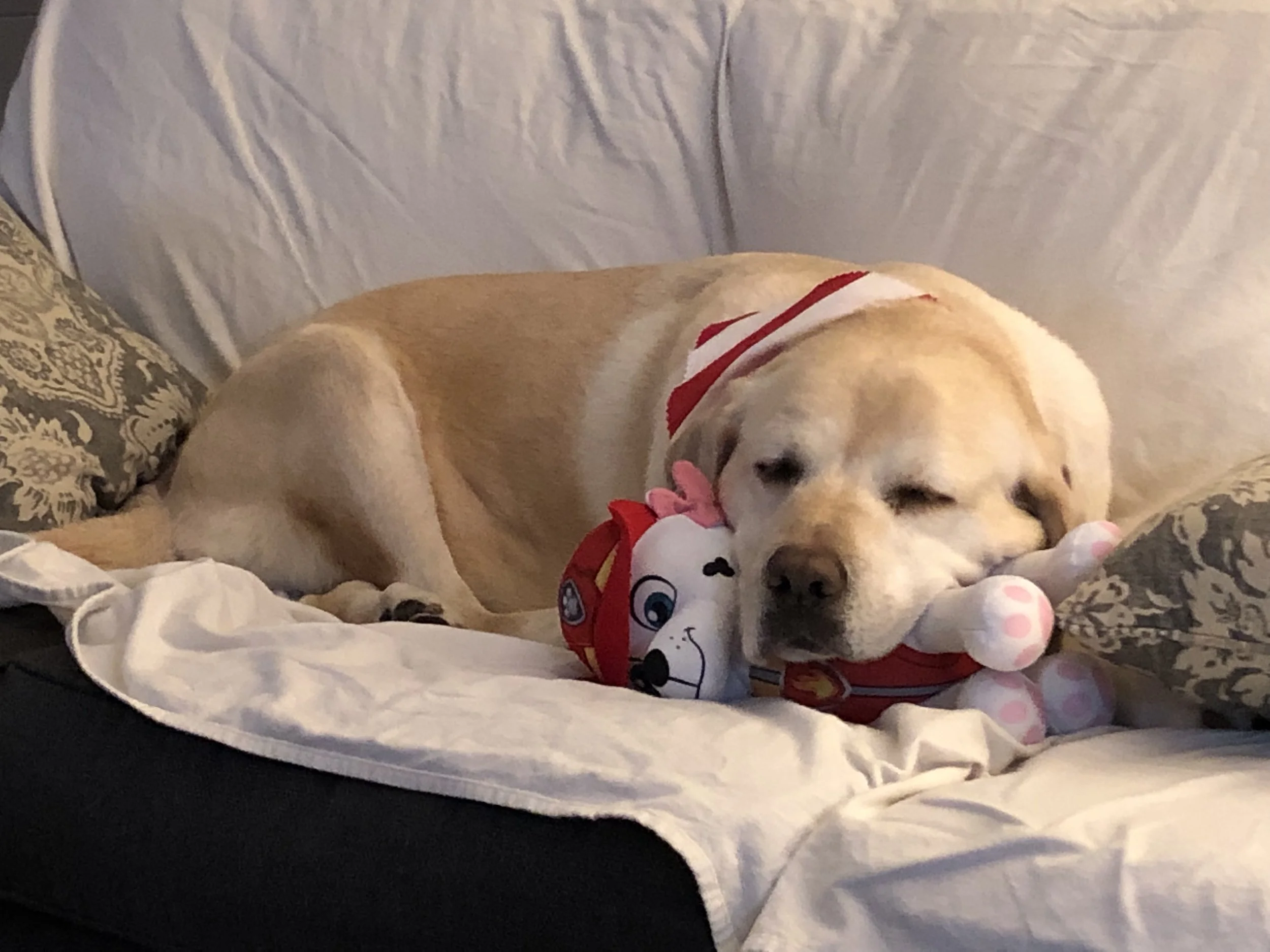
Miss Dibbs.
What we have once enjoyed, we can never lose. All that we love deeply becomes a part of us.
―Helen Keller
A certain time arrives, and your internal clock says, It’s time to feed her. Where is she?
For me, this happens repeatedly throughout the day. Noon arrives, and my body tells me it’s time for her lunch and medication. Late afternoon comes, and I instinctively think, I need to get up and take care of her. In the evening, I expect to feel movement in the room, or the familiar head bob that means I’m coming over for scratches. Each time these things happen, there is a brief, disorienting pause before reality catches up.
Her name was Miss Dibbs. She was a large, 130-pound yellow lab, the kind of dog whose presence filled a room joyfully, without effort. She didn’t just live alongside me; she structured my days.
When she died on January 15, 2025, the day still went on, but the one who gave the day its rhythm was suddenly gone. It is a noticeable physical absence. And it is relentless.
I have read that grief always begins with love, and I have come to believe that the intensity of our grief is proportional to the depth of our love. Miss Dibbs has shown me that. The more we love, the more it hurts when that love suddenly has nowhere to go.
Grief can come not only from the death of a person or an animal, but also from the death of our routine, of a physical presence that quietly structured our days. When a beloved pet dies, the loss is not just emotional; it affects time and space. The house feels wrong.
In the hours, days, weeks, sometimes months, after the loss, we cannot feel anything except absence. The one who should be there isn’t. The presence that once filled the day is gone. What remains is numbness, emptiness, and a kind of existential grief layered on top of the loss itself. It feels disorienting, as if the floor has dropped out from under you.
An intense longing. A quiet despair.
To add to this, I am especially good at questioning myself after the fact. Self-blame, in particular, is my strong suit. Did I do enough? Did I appreciate the time we had enough? Did I pay close enough attention, often enough, when it mattered?
With Miss Dibbs, these questions come fast and furious, and at any time. I replay our ordinary days together: my quiet coworker lying beside me, my porch bird-watching companion, my walking buddy, and suddenly, those times feel insufficient. I scrutinize the final weeks and wonder if I missed something, if we waited too long, if we acted too soon. My mind morphs into a courtroom, and I am the prosecutor and the defendant. Very good at prosecuting. Defending? Not so much.
This is one of grief’s favorite tricks: it takes years of faithful, loving presence and reframes it as not enough. It convinces us that love should have been perfect at every moment. An impossible standard, of course.
Another trick grief plays is convincing us that this is how it will always feel. I fall into that trap easily (knucklehead that I am), hijacked by the intensity of the emotion. It feels permanent, even though nothing ever is.
As the Buddhists remind us, all things are impermanent. Even grief.
Time is the antidote, the remedy. Although it does not erase the pain, it does change it. The sharp edges soften. The weight lifts a little. Grief comes and goes rather than occupying every single moment. Slowly, almost without noticing, it becomes easier to remember the happy moments, and eventually easier to carry the sad ones alongside them.
I know this because I have been here before.
Years ago, after my dog Calvin died, I was inconsolable. The grief was all-consuming, and my core competency skills, guilt and second-guessing, kicked into high gear. It felt endless at the time. I could not imagine how that pain could ever loosen its grip.
But it did.
Not all at once, mind you, and not because I willed it to. Over time, the ache softened on its own schedule. The memories that once caused me such pain began to carry warmth instead. And one day, unexpectedly, I felt something different. Not absence, but recognition. A feeling like, oh… there you are, Calvin.
In that moment, the relationship hadn’t disappeared. It had changed form. What remained was not the feeling of loss, but love that no longer needed a body to be felt.
I had experienced something like this once before, long ago, with another dog named Ernie.
Ernie died suddenly, without warning, and the grief that followed was deeper, in some ways, than anything I had known before. For months, I was barely functional. Sleep was elusive. The sadness felt permanent.
Years later, long after that grief had softened, I was sitting on a park bench when a large dog, a near twin of Ernie, right down to his size and coloring, broke free from his owner and ran straight toward me, passing people and benches without hesitation. He jumped up on me, tail wagging, unmistakably choosing me. The owner rushed over and regained the leash, saying “I don’t know what happened; he’s never done this before.”
That moment didn’t reopen the wound. It did something else.
It wasn’t grief I felt then, but recognition. An oh… there you are. Still with me, Ernie, moment.
This doesn’t erase what I feel now for Miss Dibbs. Her absence is still too fresh, too noticeable. The house still expects her. My mind still looks for her.
But it reminds me that grief does not have a single final form.
I don’t know exactly what persists, but I know that love leaves a recognizable footprint. And sometimes, when that footprint appears, I recognize it. And it recognizes me.
Not physically. That is impossible.
But still… present.
Because that is what their love does.
It stays.
And someday, maybe on a walk, or sitting on the porch watching the birds, I’ll feel it. And I will think “oh… there you are, Miss Dibbs.”